Located a few miles offshore this sand bank has been both a protector and nemesis for an estimated 2,000 ships (more if we count those vessels whose remains lay unrecorded).
It was once thought that it was the remains of an island called Lomea, which a historian, called Gattie, thought came from an ancient Roman reference to an island they called Infera Insula or ‘Low Island’. It was said that Earl Godwin, the father of Harold, the last Saxon King of England, owned the island, but when he fell out of favour with the King (Edward the Confessor), gave the island to St. Augustine’s Abbey in Canterbury, who failed to upkeep the sea defences and therefore it sank beneath the waves in around 1099, during a great storm. The Earl’s name lives on in the name of the sand bank.
Modern thinking suggests that the island never existed and that the Goodwins once formed part of a chalk ridge from England to France. This chalk ridge was washed away in an inundation sometime between 7600 and 5000 BCE. This flooding formed the straits of Dover.
At some time since that period various sand banks were formed. Sand is formed from organic matter, by weathering of rocks and from alluvium washed down the various rivers that drain into the North Sea and English Channel. Locally we have the Brake sands located near Ramsgate and a reason why the harbour needs constant dredging to maintain navigation within it.
The Goodwin sands are larger and constantly on the move, which is why wreck sites appear and disappear, like ghosts. Protecting ships from the sands were up to 5 light vessels, which were bombed, rammed or sunk by storm and tempest; yet even after the tragic loss of the South Goodwin Lightship in 1954, they continued to protect vessels from the sands, until they were removed or replaced by automatic light vessels. Today there is only one light vessel the East Goodwin automatic.
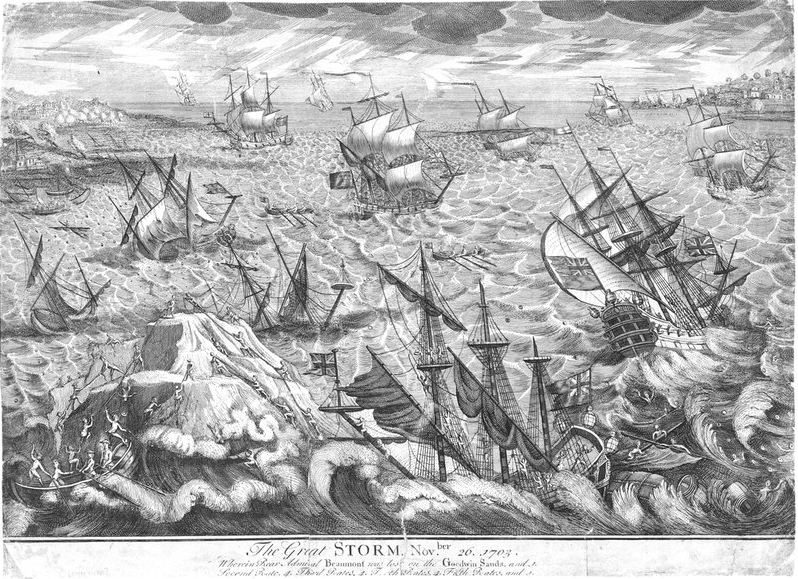
It must be remembered that the Goodwins also provided shelter as vessels congregated in the sea between them and the coast near Deal. This is known as the Downs and vessels anchored here during bad weather. In 1703 a great storm arose, possibly the storm of the century, where HMS Stirling Castle was driven on to the sands, along with Rear Admiral Beaumont, 1500 sailors and 12 other ships. This was the Royal Navy’s entire channel squadron. Parts of the Stirling Castle were recovered many years later and can be seen in the Maritime Museum and elsewhere.
You can read all about this storm, as it was described by Daniel Defoe in one of the first detailed descriptions of a major climatic event. The reaction after the event was spoken of as God’s wrath in response to a sinful humanity.
More to the point, the storm led to the construction of Ramsgate harbour as a safe refuge and perhaps the death of all those men did pluck the flower of safety, from the nettle of danger.
The story of the Goodwin sands continues to this day and if it remains undisturbed it may yet surprise us with fresh discoveries.